Tips for a Smarter You …
- Sleep
Sleep is not only essential for regenerating your physical body, but
it is imperative for reaching new mental insights and being able to see
new creative solutions to old problems. Sleep removes the blinders and
helps "reset" your brain to look at problems from a different
perspective, which is crucial to creativity.
Research from Harvard indicates that people are 33 percent more likely to infer connections
among distantly related ideas after sleeping, but few realize that
their performance has actually improved. Sleep is also known to enhance
your memories and help you "practice" and improve your performance of
challenging skills. In fact, a single night of sleeping only four to six
hours can impact your ability to think clearly the next day.
The process of growth, known as plasticity,
is believed to underlie the brain's capacity to control behavior,
including learning and memory. Plasticity occurs when neurons are
stimulated by events, or information, from the environment. However,
sleep and sleep loss modify the expression of several genes and gene
products that may be important for synaptic plasticity. Furthermore,
certain forms of long-term potentiation, a neural process associated
with the laying down of learning and memory, can be elicited in sleep,
suggesting synaptic connections are strengthened while you slumber.
As you might suspect, this holds true for infants too, and research
shows that naps can give a boost to babies' brainpower. Specifically,
infants who slept in between learning and testing sessions had a better
ability to recognize patterns in new information, which signals an
important change in memory that plays an essential role in cognitive
development.vi Even among adults, a mid-day nap was found to dramatically boost and restore brainpower.
2. Vitamin D
Activated vitamin D receptors increase nerve growth in your brain,
and researchers have also located metabolic pathways for vitamin D in
the hippocampus and cerebellum of the brain, areas that are involved in
planning, processing of information, and the formation of new memories.
The National Institutes of Mental Health recently concluded that it is vital that
the mother get enough vitamin D while pregnant in order for the baby's
brain to develop properly. The child must also get enough vitamin D
after birth for "normal" brain functioning. In older adults, too,
research has shown that low vitamin D levels are associated with poorer
brain function, and increasing levels may help keep older adults
mentally fit.viii
Appropriate sun exposure would take care of these issues, as the sun
is irreplaceable when it comes to the body's ability to produce adequate
amounts of vitamin D.
Appropriate sun exposure is all it takes to keep your levels where
they need to be for healthy brain function. If this is not an option, a
safe tanning bed is the next best alternative, followed by a vitamin D3
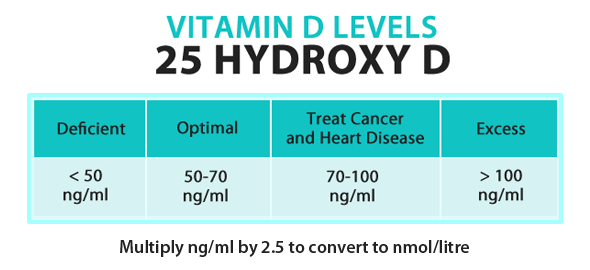
supplement. It now appears as though most adults need about 8,000 IU's
of vitamin D a day in order to get their serum levels above 40 ng/ml,
which is the lowest they should be. Ideally, your serum levels should be
between 50-70 ng/ml, and up to 100 ng/ml to treat cancer and heart
disease. However, it's important to realize that there's no magic dosage
when it comes to vitamin D. What's important is your serum level, so
you need to get your vitamin D levels tested to make sure you're staying
within the optimal and therapeutic ranges as indicated below.
3. Challenge Your Mind
One of the simplest methods to boost your brain function is to keep
on learning. The size and structure of neurons and the connections
between them actually change as you learn. This can take on many forms
above and beyond book learning to include activities like traveling,
learning to play a musical instrument or speak a foreign language, or
participating in social and community activities.
Another important method? Brain aerobics. As with learning,
challenging your brain with mind-training exercises can keep your brain
fit as you age. This can be something as simple as thinking of famous
people whose first names begin with the letter A, doing crossword
puzzles or playing board games that get you thinking. Research has even
shown that surfing the Web activates regions in your brain related to
decision-making and complex reasoning.xiii So unlike passively watching TV, using the Internet is an engaging task that may actually help to improve your brainpower.
for more information on this you can read further at this website good-brain-health-tips

No comments:
Post a Comment
Note: only a member of this blog may post a comment.